
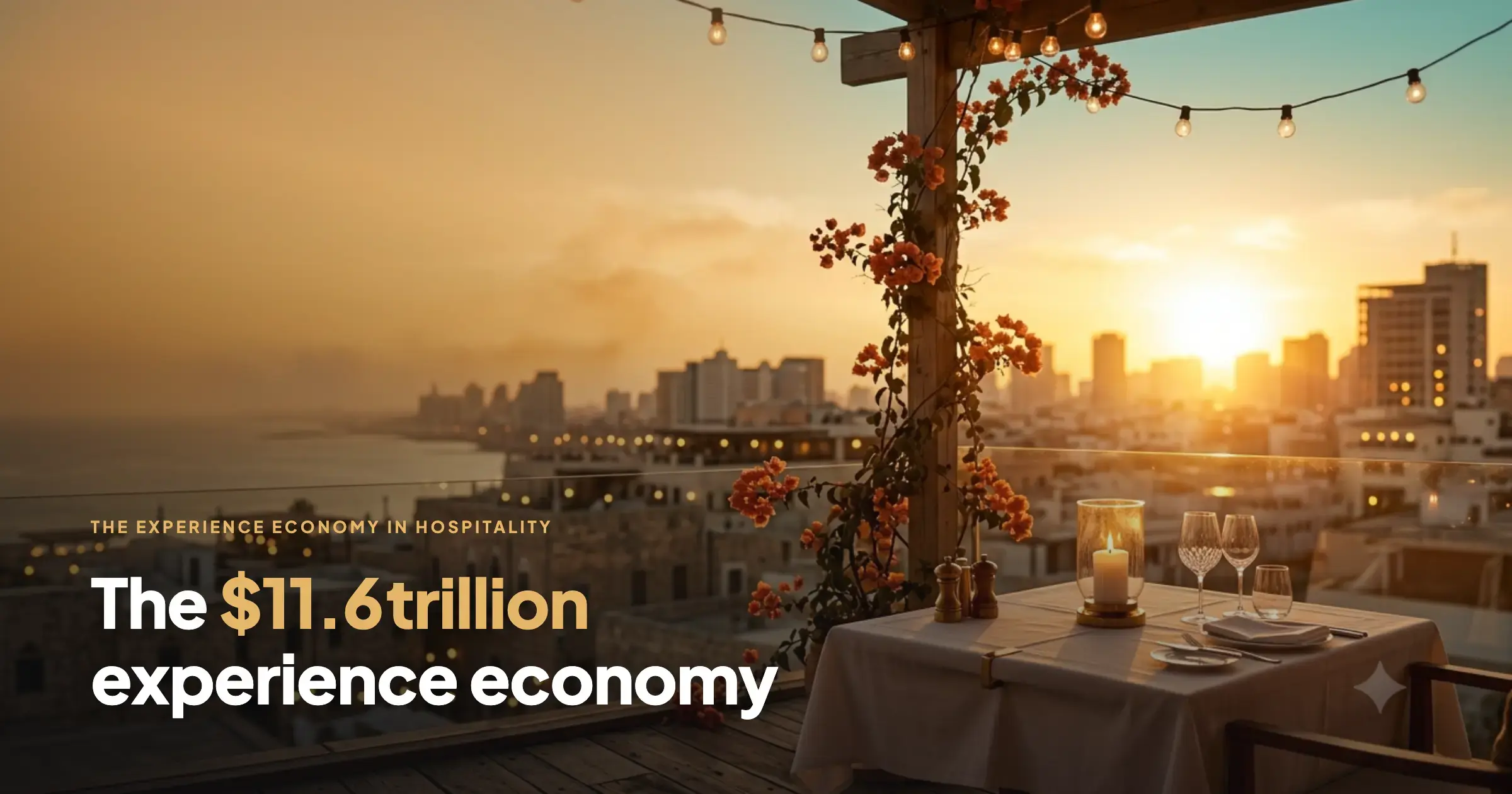
Travel and tourism contributed a record $11.6 trillion to the global economy in 2025, close to a tenth of everything the world spent. That figure tells you something a booking report never will. People are pouring money into being somewhere, doing something, feeling something. The room is the smallest part of it.
Watch what travellers choose and the pattern sharpens. In 2025, 73% of people said they would travel for an experience that interested them, and the frequent ones among them said they would pay more for it. Your customer is weighing a night in your hotel against every other memory they could buy that week, and the room rate down the road barely enters the comparison.
That is the experience economy, and hospitality sits closer to its centre than almost any other industry. Here is what the data says, and what it changes about the way a hotel sells.
The Sector Grew Faster Than the Economy Around It, and APAC Led Every Region
The growth matters even more than the size here. Travel and tourism expanded 4.1% in 2025 while the wider global economy managed 2.8%. Demand for going places and doing things is outrunning demand for almost everything else, and it does so from an already enormous base.
Asia-Pacific set the pace, growing 8.1% to lead every region in the world. That is where the appetite is building fastest, and where a hotel that sells experiences well has the most room to run. Money is moving towards experiences faster than most revenue plans have noticed.
Travellers Come for the Experience and Treat the Room as the Container
Ask people what pulled them to book and they name the thing they will do. It is rarely the bed they will sleep in. The research is blunt on this: nearly three in four will travel for an experience that interests them. Later industry trend reports land in the same place, with travellers increasingly prioritising experiences over possessions.
For a hotel, that reframes the entire inventory. The spa, the tasting menu, the rooftop at golden hour, the suite with the view: these are the products buyers are actually shopping for. Experience commerce is the practice of selling them as products rather than burying them in a service list. Sell the memory and the room comes along for the ride.
Personalisation Is What Turns a Browser Into a Buyer
Interest is not the same as a sale, and this is where hotels can lose the transaction. Around 80% of consumers are more likely to buy when a brand offers a personalised experience. Generic sells poorly, while specific sells well.
A named package does the personalising for you. "A Morning to Yourself" with a treatment, a glass of something and a late checkout gives the buyer a moment to picture. An open-value gift card gives them a sum of money and a decision to make later. Experience vouchers outsell monetary cards for exactly this reason: a named moment hands over a feeling where a balance hands over homework. The more precisely you name the moment, the faster it sells.
The Experience Buyer Is Often Buying for Themselves
Gifting data tells us up to 62% of consumers buy gift cards for themselves, treating a card as permission to enjoy something they would not otherwise book. The same research put the average self-purchase at around $55, running higher than the typical card bought as a present. People spend up when the treat is for them. The gifting occasion drives self-purchase as much as it drives gifts to others.
Read that through a hotel's product shelf and it opens a second audience. The spa afternoon sells as an anniversary gift, it also sells to the customer who has had a punishing quarter and decides they have earned it. Dining and spa experiences are the natural entry points here, because they carry an easy reason to treat yourself. Build the catalogue for givers and you win the self-gifters for free.
The Experiences-First Hotel Outsells the Rooms-First Hotel on the Same Inventory
Two hotels can hold identical assets and sell them completely differently. One lists a "Deluxe Room" and a "60-Minute Massage" on separate pages, priced like a transaction. The other sells "A Weekend That Feels Like a Reset", one product, one story, one price. Same building, same cost base, very different revenue.
The difference is packaging and presentation, and it is learnable. A storefront built for experiences leads with the feeling, shows the moment in warm light, and keeps the operational detail underneath for the buyer who wants it. A purpose-built gifting platform like Ryse exists to make that presentation the default rather than a project, so every giftable moment in the building has somewhere to be sold. The inventory was always there. The framing is what gets paid for.
The experience economy already arrived in hospitality, already worth $11.6 trillion, and it pays out to the hotels that sell the feeling their customers came for.
Common Questions About the Experience Economy in Hospitality
How big is the travel and tourism sector?
Travel and tourism contributed a record $11.6 trillion to the global economy in 2025, about 9.8% of world GDP. The sector grew 4.1% that year, outpacing the wider global economy, and Asia-Pacific led all regions with 8.1% growth.
Do travellers really prefer experiences over things?
The evidence points that way. In 2025, 73% of people said they would travel for an experience that interested them, and frequent travellers said they would pay more for it. Later trend research reached the same conclusion, with travellers increasingly prioritising experiences over possessions.
What is the experience economy in hospitality?
It is the move in consumer spending away from products and towards experiences worth having and remembering. In hospitality it means people value the meal, the spa afternoon or the occasion more than the room itself, and they buy accordingly. Hotels that package and sell experiences capture more of that spend than those still selling a bed for the night.
Why does personalisation matter for selling hotel experiences?
Because it moves people from browsing to buying. Around 80% of consumers are more likely to purchase when a brand offers a personalised experience. A named, occasion-led package converts far better than an open-value voucher, because it lets the buyer picture the exact moment they are giving or taking.
If you want every giftable experience in your hotel presented the way the numbers reward, Ryse Cloud is built to sell them.
Sources
- Travel & Tourism global GDP contribution 2025, World Travel & Tourism Council
- Evolving Immersive: The 2025 Immersive Entertainment & Culture Industry Report, Gensler Research Institute
- New Epsilon research: 80% of consumers more likely to purchase with personalised experiences, Epsilon
- 21st Annual Prepaid Consumer Insights Survey, Carat from Fiserv
- The Year of the Great Recharge: Hilton Trends Report 2024, Hilton